The 14-Day Experiment
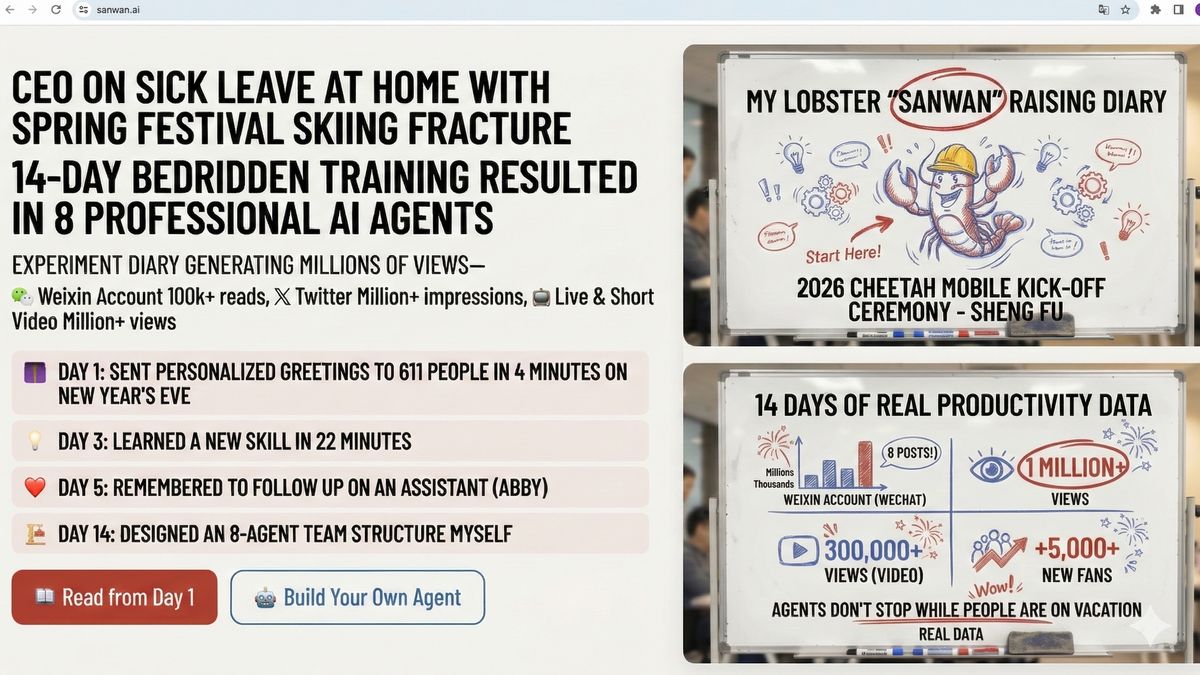
During the 2026 Chinese New Year holiday, Cheetah Mobile CEO Fu Sheng found himself bedridden for 14 days. Rather than resting, he spent the entire time doing what the Chinese OpenClaw community calls "raising lobsters" — building, training, and iterating on AI agents powered by OpenClaw.
He started with a single agent he named "Sanwan" (Three Ten Thousand). By the end of the two weeks, Sanwan had evolved into a team of 8 specialized agents running 24/7, handling everything from email triage to research summaries to scheduled reporting.
The experiment produced 220,000 characters of conversation logs and a clear conclusion: OpenClaw is extraordinarily powerful, but its setup process is a dealbreaker for 99% of potential users.
The Problem: OpenClaw's Last Mile
Setting up a functional OpenClaw agent requires:
- •Installing a runtime environment on a server
- •Configuring API keys for one or more AI providers
- •Setting permissions and security policies
- •Manually installing skill plugins
- •Debugging cron jobs, vector memory, and multi-agent orchestration
For a developer, this takes about 3 hours on a good day. For a non-technical user, it can take 3 days — or never happen at all.
Fu Sheng recognized that this "last mile" problem is the single biggest barrier to mass adoption. The intelligence is there. The infrastructure is there. But the onboarding experience is broken.
Enter EasyClaw
EasyClaw is Cheetah Mobile's answer to the last-mile problem. It is a productized wrapper around OpenClaw that eliminates the deployment barrier entirely:
- •Double-click install: No command line, no terminal, no server configuration
- •No API key required: EasyClaw bundles its own AI backend, so users do not need to sign up for Anthropic, OpenAI, or any other provider
- •3-minute setup: From download to working agent in under 3 minutes
- •Built-in everything: Memory systems, skill mechanisms, scheduled automation, and multi-agent collaboration are all packaged as out-of-the-box features
Product Matrix
EasyClaw ships in three editions:
- •EasyClaw (International) — for global individual users, available at easyclaw.com
- •EasyClaw Work — for enterprise teams, available at easyclaw.work
- •Yuanqi AI Bot (元气 AI Bot) — for Chinese domestic users, integrates with Chinese LLMs like Qwen, DeepSeek, and Kimi, ensuring compliance with local regulations and optimal performance for Chinese-language tasks
The international version runs on global AI providers. The domestic version is localized for the Chinese market with native model support.
Why This Matters for OpenClaw
Some in the community see products like EasyClaw as competitors. We see them as ecosystem accelerators.
OpenClaw's core strength is its open-source flexibility — the ability to customize, extend, and self-host. But that flexibility comes at a cost: complexity. Products like EasyClaw serve users who will never open a terminal but still want an AI agent that works. Many of these users will eventually graduate to the full OpenClaw experience as their needs grow.
Fu Sheng's 14-day experiment also produced something else: real-world stress testing at scale. The bugs he filed, the edge cases he discovered, and the UX friction he documented have directly informed improvements in the core OpenClaw codebase.
The Lobster Culture
The term "raising lobsters" (养龙虾) has become a cultural phenomenon in China's tech community. OpenClaw's lobster mascot resonated deeply — users treat their agents as digital pets that grow smarter over time. Social media is filled with posts about lobster "personalities," achievements, and failures.
Fu Sheng's public documentation of his lobster-raising journey — complete with screenshots, frustrations, and breakthroughs — has been shared tens of thousands of times on Weibo and WeChat. It has done more for OpenClaw awareness in China than any marketing campaign could.
What's Next
EasyClaw is still in its early days, but the direction is clear: make AI agents accessible to everyone, not just developers. If OpenClaw is Linux, EasyClaw wants to be Ubuntu — same power, radically simpler interface.
For the OpenClaw ecosystem, this is a net positive. More users means more feedback, more skills, more integrations, and a larger community pushing the platform forward.